
Artificial Intelligence (AI) and automation are rapidly changing the way businesses operate. Housekeeping and facility management are no exception.
Traditionally, housekeeping has been a highly people-intensive operation. Supervisors monitor teams, employees perform cleaning activities, managers review reports and customers provide feedback. Much of the supporting work—attendance tracking, checklists, reporting, follow-ups and data consolidation—is still performed manually.
AI and automation can change this model.
The objective, however, should not be to replace people.
The real opportunity is to use AI and automation to help housekeeping teams work smarter, help supervisors manage better and help management make faster, data-driven decisions.
- What Does AI Mean for Housekeeping?
AI in housekeeping does not necessarily mean sophisticated robots or expensive technology.
AI can be used in everyday operational activities such as:
- Analysing housekeeping data
- Identifying recurring complaints
- Preparing management reports
- Predicting manpower requirements
- Analysing inspection results
- Identifying unusual consumption patterns
- Generating training recommendations
- Summarising customer feedback
- Supporting supervisors with information
- Automating routine communication
In simple terms:
Automation performs repetitive work. AI helps people understand information and make better decisions.
- Automating Routine Administrative Work
Housekeeping operations involve a significant amount of repetitive administrative work.
Once information is captured digitally, automation can move the information to the right person, generate reports and trigger reminders without requiring someone to manually perform the same task every day.
This allows supervisors and managers to spend more time on operations rather than administration.
- AI-Powered Housekeeping Dashboards
A conventional dashboard tells management what has happened.
An AI-enabled dashboard can go a step further by helping management understand why it happened and what may need attention next.
Instead of simply presenting numbers, AI can highlight:
“Site performance has declined over the last three weeks, with repeated complaints in washroom cleaning and increased absenteeism.”
This type of insight can help managers focus their attention where it matters most.
- Predictive Manpower Management
Manpower planning is one of the biggest challenges in housekeeping operations.
Unexpected absenteeism, employee turnover, new contracts and changes in customer requirements can create operational pressure.
AI can analyse historical information such as:
- Attendance patterns
- Absenteeism
- Employee turnover
- Site workload
- Shift requirements
- Historical manpower shortages
This information can help management anticipate potential manpower problems.
The result is a shift from reactive manpower management to proactive manpower management.
- Smarter Cleaning Schedules
Not every area requires the same cleaning frequency.
A high-traffic washroom, production area or reception zone may require more frequent attention than a low-traffic area.
AI can potentially analyse these patterns and cleaning schedules can be optimized.
Instead of following exactly the same routine throughout the day, housekeeping resources can be directed toward areas where they are most needed.
This can improve both service quality and workforce productivity.
- AI-Assisted Quality Inspection
Quality inspection is another area where technology can support housekeeping teams.
Digital inspection forms already make it easier to record observations.
In advanced applications, computer vision can also support visual inspection of certain environments by identifying visible issues such as waste accumulation or cleanliness deviations.
However, technology should complement—not replace—the judgement of trained supervisors.
- Intelligent Complaint Management
Customer complaints contain valuable operational information.
Consider hundreds of complaints collected over several months.
A manager may not have the time to read every complaint and identify patterns manually.
AI can analyse complaint data and classify it into categories such as:
- Cleaning quality
- Washroom hygiene
- Manpower
- Behaviour
- Grooming
- Material availability
- Equipment
- Safety
- Response time
It can then identify recurring themes.
This information helps management determine where improvement efforts should be concentrated.
- Automated Follow-Ups
One of the simplest and most useful applications of automation is follow-up management.
Housekeeping operations generate hundreds of actions.
Automation can monitor deadlines and send reminders to responsible people.
This reduces dependence on memory and manual follow-up.
- AI for Training and Skill Development
Training is critical to consistent housekeeping quality.
AI can help organizations identify training requirements based on operational data.
For example, if a particular site repeatedly records issues related to floor cleaning, the system can identify the trend and recommend refresher training.
AI can also assist in creating:
- Training content
- Short learning modules
- Quiz questions
- Assessment forms
- Training summaries
- Multilingual training material
This is particularly valuable for organizations managing a large and diverse workforce.
- Smart Equipment and Robotic Cleaning
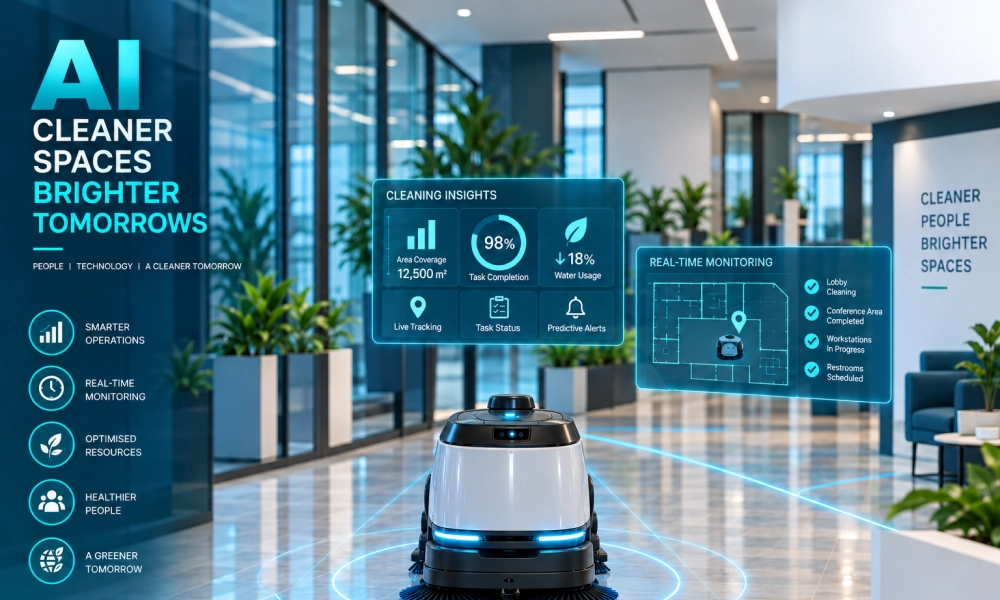
Robotics represents one of the more visible applications of automation in housekeeping.
These technologies can be particularly useful in large facilities where repetitive floor-cleaning activities consume significant manpower hours.
However, robots are not a universal replacement for housekeeping employees.
The future is likely to be human-led operations supported by intelligent machines.
- AI and Automation: A Practical Approach
Organizations do not need to implement everything at once.
A practical digital transformation can start with simple opportunities.
Stage 1 – Digitize
Move paper-based processes to digital formats.
Stage 2 – Automate
Automate repetitive reports, reminders and notifications.
Stage 3 – Analyse
Create dashboards and identify operational trends.
Stage 4 – Introduce AI
Use AI to interpret information, identify patterns and support decision-making.
Stage 5 – Optimize
Use predictive analytics, intelligent scheduling and smart equipment where they provide measurable value.
This approach reduces unnecessary investment and allows organizations to learn from each stage.
- The Human Element Remains Central
Technology may change housekeeping operations, but people will remain at the centre of the service.
A machine can clean a floor.
But a trained professional understands:
- Customer expectations
- Workplace behaviour
- Safety requirements
- Special cleaning requirements
- Unexpected situations
- Team coordination
- Service quality
AI can identify a trend.
A manager must decide what action to take.
Automation can send a reminder.
A supervisor must ensure that the work is actually completed.
This distinction is important.
Technology provides capability. People provide judgement, responsibility and service.
Our Perspective
At Sparkle Services, we believe technology should be introduced with a clear operational purpose.
AI and automation should not be implemented simply because they are fashionable technologies.
They should answer practical questions:
Can this reduce repetitive work?
Can this improve service quality?
Can this help supervisors?
Can this provide better visibility to management?
Can this improve customer experience?
Can this reduce avoidable errors and delays?
When the answer is yes, technology becomes a powerful enabler of better housekeeping.
Conclusion
The housekeeping industry is entering an exciting phase.
AI, automation, digital platforms, analytics, smart equipment and connected systems are creating opportunities to improve the way housekeeping services are planned, executed, monitored and improved.
But successful transformation will not come from technology alone.
It will come from the right combination of:
People + Processes + Technology + Data + Leadership
The future housekeeping operation will therefore not simply be more automated.
It will be more intelligent, more measurable, more responsive and more customer-focused.
At Sparkle Services, we see AI and automation not as a replacement for professional housekeeping teams, but as an opportunity to empower them to deliver smarter, faster and more consistent service.
The future of housekeeping is human-led, technology-enabled and data-driven.
Image Description – Show image of robotic cleaning machine with some graphics on the screen in may be corporate office background. Add some AI analysis conclusion as graphics.